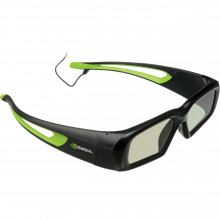
3D Vision (previously GeForce 3D Vision) is a stereoscopic gaming kit from Nvidia which consists of LC shutter glasses and driver software which enables stereoscopic vision for any Direct3D game, with various degrees of compatibility. There have been many examples of shutter glasses over the past decade, but the NVIDIA 3D Vision gaming kit introduced in 2008 introduced this technology to mainstream consumers and PC gamers.
The Drivers page or what is left of it on Nvidia's site is here: https://www.nvidia.com/en-in/drivers/GeForce-3D-Drivers-Downloads/
The kit is specially designed for 120 Hz LCD monitors. Also it is compatible with late CRT monitors (some of which may work at 1024×768×120 Hz and even higher refresh rates), DLP-projectors, and other. It requires a graphics card from Nvidia.
Shutter glasses
The glasses use wireless IR protocol and can be charged from a USB cable, allowing around 60 hours of continuous use.
The wireless emitter connects to the USB port and interfaces with the underlying driver software. It also contains a VESA Stereo port for connecting supported DLP TV sets, although standalone operation without a PC with installed Nvidia 3D Vision driver is not allowed.
NVIDIA includes one pair of shutter glasses in their 3D Vision kit, SKU 942-10701-0003. Each lens operates at 60Hz, and alternate to create a 120Hz 3-dimensional experience.
This version of 3D Vision supports select 120 Hz monitors, 720p DLP projectors, and passive-polarized displays from Zalman.
Stereo driver
The stereo driver software can perform automatic stereoscopic conversion by using the 3D models submitted by the application and rendering two stereoscopic views instead of the standard mono view. The automatic driver works in two modes: fully "automatic" mode, where 3D Vision driver controls screen depth (convergence) and stereo separation, and "explicit" mode, where control over screen depth, separation, and textures is performed by the game developer with the use of proprietary NVAPI.
The quad-buffered mode allows developers to control the rendering, avoiding the automatic mode of the driver and just presenting the rendered stereo picture to left and right frame buffers with associated back buffers.
NVIDIA 3D Vision Driver
File: NVIDIA_3D_Vision_v186.18_driver.exe
ec771530bf2ecd81eb4a75921cbeae93c1c134eee440e90a4c06e1e51c397f6b
NVIDIA 3D Vision Driver
File: NVIDIA_3D_Vision_v257.21_driver.exe
6d71bee054b6b148e6ca2ec17b0fa4bfe1b3964f123d95218c3027db61664048
3D Vision Driver for Quadro Only
File: Quadro-3D-Vision-275.33-USB-driver.exe
fb588622d3f5c4d0b3756f2a7db89461afe9e89f305253d9026899e9c3060842
NVIDIA 3D Vision Controller Driver
File: NVIDIA_3D_Vision_v260.63_driver.exe
499a4690643d875abe0b6f04702a73aa2da753b72587d941b667c3480d513c72
NVIDIA Stereoscopic 3D USB controller
File: USB Driver.zip
c5a02eff4f29d9ca9b1dd1e93138abdd73cd7f4c9707e6da62e7fa53499188f9
Show: Full Specs/Additional configurations
Device IDs:
USB\VID_0955&PID_0007
USB\VID_0955&PID_7001
USB\VID_0955&PID_7002
USB\VID_0955&PID_7003
USB\VID_0955&PID_7004
All Model numbers for this device
Desktop Displays compatable with GeForce 3D Vision
• Acer GD245HQ/GD23HZ 120 Hz LCD display
• Alienware™ OptX™ AW2310 120 Hz LCD display
• AS US® VG236H/VG236HE 120 Hz LCD display
• LG W2363D 120 Hz LCD display
• Samsung® SyncMaster™ 2233RZ 120 Hz LCD display
• Viewsonic® FuHzion™ VX2265wm 120 Hz LCD display
• 100 Hz and higher analog CRTs