Creative Music System
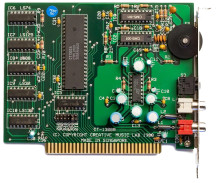
The history of Creative sound boards started with the release of the Creative Music System ("C/MS") board in August 1987. It contained two Philips SAA 1099 circuits, which, together, provided 12 voices of square-wave bee-in-a-box stereo sound plus some noise channels.
These circuits were featured earlier in various popular electronics magazines around the world. For many years Creative tended to use off-the-shelf components and manufacturers' reference designs for their early products. The various integrated circuits had white or black paper sheets fully covering their top thus hiding their identity. On the C/MS board in particular, the Philips chips had white pieces of paper with a fantasy CMS-301 inscription on them; real Creative parts usually had consistent CT number references.
Surprisingly, the board also contained a large 40-pin PGA (Creative Technology Programmable Logic) integrated circuit, bearing a CT 1302A CTPL 8708 serigraphed inscription and looking exactly like the DSP of the later Sound Blaster. Presumably, it could be used to automate some of the sound operations, like envelope control.
Game Blaster
A year later, in 1988, Creative marketed the C/MS via Radio Shack under the name Game Blaster. This card was identical in every way to the precursor C/MS hardware. Creative did not change any of the labeling or program names on the disks that came with the Game Blaster.
CMS Game Blaster Disks
File: CMS.zip
52688e5e154ec3a1d2b1a4314dd981b036a7e77fe4ab1dddb98706b6e0fdb959
CMS Game Blaster TSR
File: GBC-CMS.zip
1128917b5db955cb99da8a9ff07cbd611accdaf78b9b87dd072abed4be52e043
CMS Sound Blaster TSR
File: SBC-CMS.zip
ed4a9196717e57fc392673c6cf4d47270de9020b11551dd009e0b039e0e4b4f0
CMS Game Blaster 720KB Driver Disk
File: gameblaster_720kb.zip
cae76613bb3f403ffab9e81bcf309c8976eef1bd8560e9556b98511aadc0d8c7