Quantum computing might sound like something out of science fiction, but it’s a real and rapidly developing technology that could change how we solve complex problems. If you’re new to the topic, don’t worry—this guide breaks it down in simple terms.
What Is Quantum Computing?
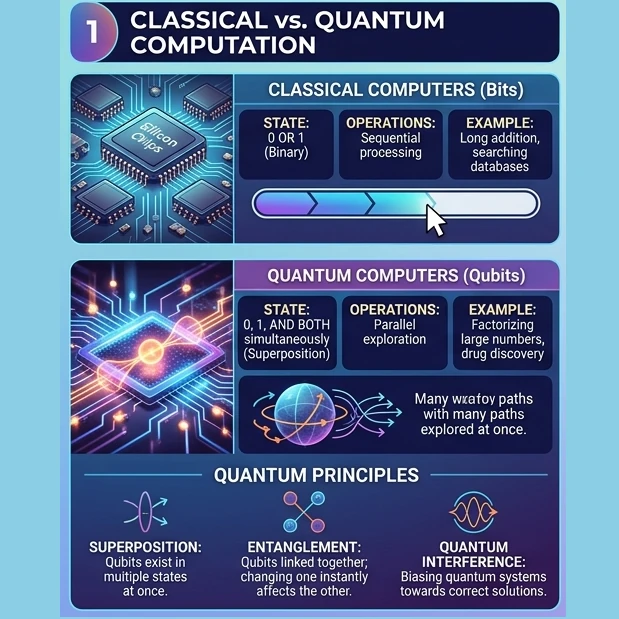
At its core, quantum computing is a new way of processing information. Traditional computers (like your laptop or phone) use bits, which can be either a 0 or a 1. Quantum computers, on the other hand, use qubits.
Thanks to a principle called superposition, a qubit can be 0, 1, or both at the same time. This allows quantum computers to handle multiple possibilities simultaneously, making them incredibly powerful for certain tasks.
How Is It Different from Classical Computing?
Regular computers process information step by step. Quantum computers take a different approach by using:
- superposition – enables multiple states at once
- entanglement – links qubits together so they affect each other instantly
- quantum interference – helps refine and amplify correct answers
These principles allow quantum machines to explore many solutions at once instead of checking them one by one.
Why Does Quantum Computing Matter?
Quantum computing isn’t about replacing your everyday PC—it’s about solving problems that are too complex for classical computers.
Some real-world applications include:
- Drug discovery – simulating molecules at an atomic level
- Cryptography – improving (or breaking) current encryption methods
- Optimization problems – improving logistics, traffic flow, and supply chains
- Artificial intelligence – speeding up complex data analysis
Companies like IBM, Google, and Microsoft are heavily investing in this field.
How Do Quantum Computers Work?
Quantum computers rely on the laws of quantum mechanics. Instead of electrical signals like traditional computers, they use quantum states of particles such as electrons or photons.
These systems are extremely sensitive and often require:
- Ultra-cold temperatures (close to absolute zero)
- Specialized hardware
- Isolation from environmental noise
Because of this, quantum computers are currently large, expensive, and mostly used in research settings.
Are Quantum Computers Available Today?
Yes—but with limitations.
Quantum computers exist today, but they are still in the early stages. Most are accessed through cloud platforms provided by companies like IBM and Google.
They are not yet practical for everyday tasks like browsing the web or gaming. However, progress is happening quickly.
Challenges of Quantum Computing
Despite the hype, there are still major hurdles:
- Error rates – Qubits are fragile and prone to errors
- Scalability – Building large, stable systems is difficult
- Cost – Extremely expensive to develop and maintain
Researchers are actively working on solutions, including quantum error correction.
Final Thoughts
Quantum computing is still evolving, but its potential is enormous. While it won’t replace your home computer anytime soon, it could revolutionize industries like medicine, cybersecurity, and logistics.
For beginners, the key takeaway is simple: quantum computers don’t just work faster—they work differently. By leveraging the strange rules of quantum physics, they open the door to solving problems that were once considered impossible.