Samsung recently sent users another reminder buried inside its privacy notices and smart TV policies: your television is not just a display anymore. It is a data-collecting device connected directly to one of the largest advertising and analytics ecosystems in the world.
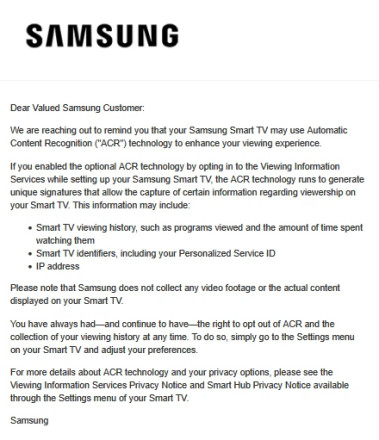
Dear Valued Samsung Customer:
We are reaching out to remind you that your Samsung Smart TV may use Automatic Content Recognition ("ACR") technology to enhance your viewing experience.
If you enabled the optional ACR technology by opting in to the Viewing Information Services while setting up your Samsung Smart TV, the ACR technology runs to generate unique signatures that allow the capture of certain information regarding viewership on your Smart TV. This information may include:
- Smart TV viewing history, such as programs viewed and the amount of time spent watching them
- Smart TV identifiers, including your Personalized Service ID
- IP address
Please note that Samsung does not collect any video footage or the actual content displayed on your Smart TV.
You have always had—and continue to have—the right to opt out of ACR and the collection of your viewing history at any time. To do so, simply go to the Settings menu on your Smart TV and adjust your preferences.
For more details about ACR technology and your privacy options, please see the Viewing Information Services Privacy Notice and Smart Hub Privacy Notice available through the Settings menu of your Smart TV.
Samsung
Modern smart TVs from companies like Samsung can collect enormous amounts of information about how people use their devices. This may include viewing habits, app usage, voice commands, search history, connected devices, approximate location data, and even content recognition technology that monitors what is being watched on-screen.
Many consumers still assume their television works like older TVs from the 1990s or early 2000s — a relatively passive device. In reality, today’s smart TVs function more like oversized smartphones loaded with tracking systems, advertising IDs, telemetry, and internet-connected analytics software.
One of the more controversial technologies used across the smart TV industry is ACR (Automatic Content Recognition). ACR can identify shows, movies, games, or broadcasts playing on the screen regardless of whether the content comes from cable, streaming apps, game consoles, or even external HDMI devices. This information can then be used for targeted advertising, recommendation engines, and broader consumer behavior analysis.
Samsung is far from alone. Companies including LG Electronics, Roku, Amazon, and Google all participate in increasingly aggressive data collection ecosystems tied to televisions and streaming hardware.
The uncomfortable reality is that many modern electronics are partially subsidized by long-term data collection and advertising revenue. Lower hardware prices are often offset by monetization happening quietly in the background after the device is installed in your home.
Most users scroll past privacy agreements during setup without realizing how extensive the permissions may be. While many tracking features can technically be disabled, the settings are often buried deep inside menus and occasionally re-enabled after firmware updates.
For privacy-conscious users, disconnecting a smart TV from the internet entirely or using an external streaming box with tighter privacy controls may offer a more controlled experience. But even then, avoiding data collection completely has become increasingly difficult in the modern consumer technology landscape.